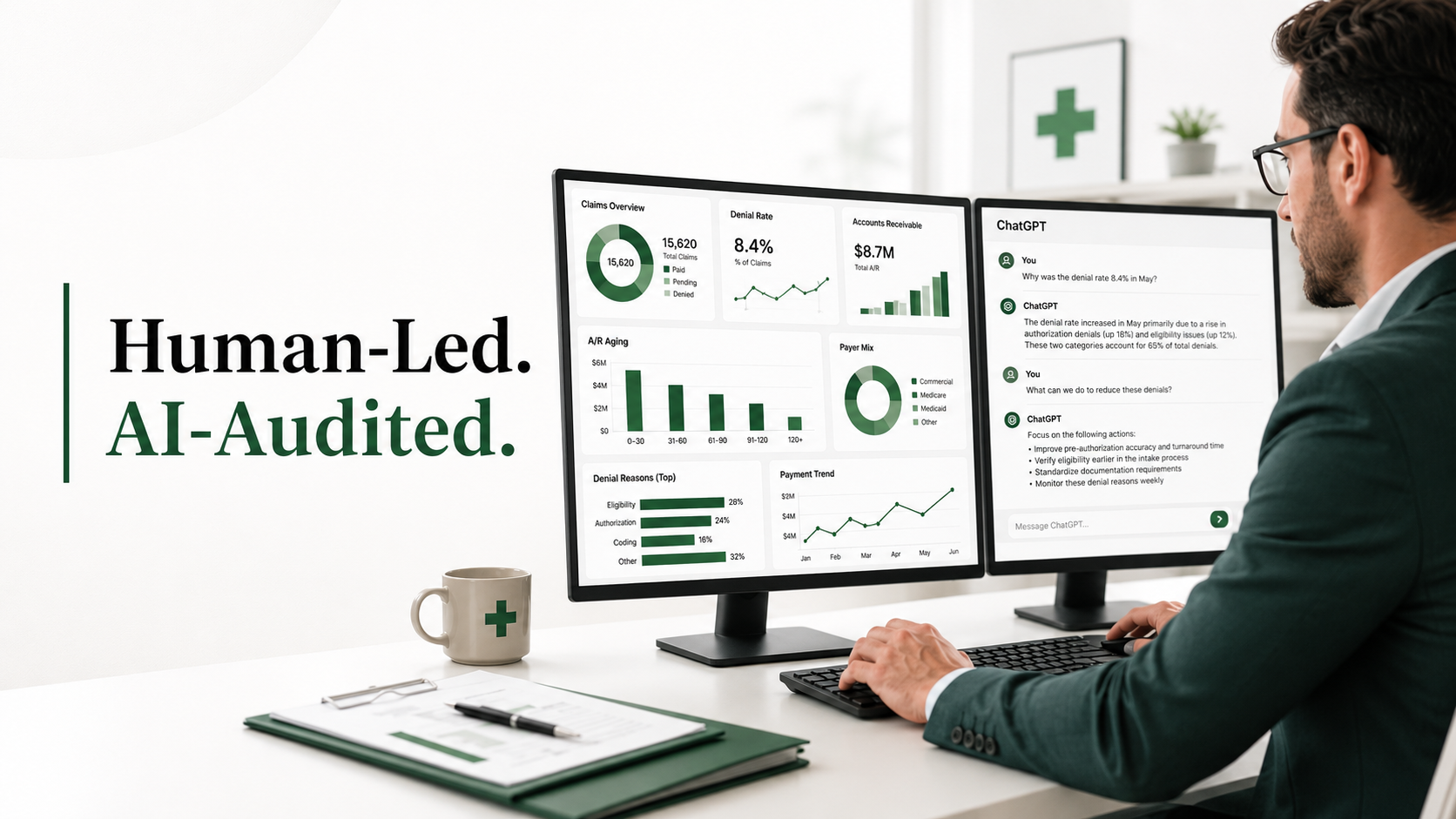
Artificial intelligence is quickly becoming part of the healthcare revenue cycle conversation, but the most valuable use case may not be full automation. At least not yet.
For hospitals, labs, physician groups, and other care delivery organizations, revenue cycle management is under pressure from multiple directions: rising denial complexity, payer friction, staffing constraints, fragmented systems, and higher expectations from leadership. Recent healthcare surveys show that revenue cycle is no longer just a back-office function. It is becoming a strategic capability tied directly to margin stability, cash flow, and organizational resilience.
That shift creates a practical question for healthcare finance and operations teams: How do we use AI to improve revenue cycle analysis without removing the human context that makes the analysis useful?
My answer is a human-led, AI-audited workflow.
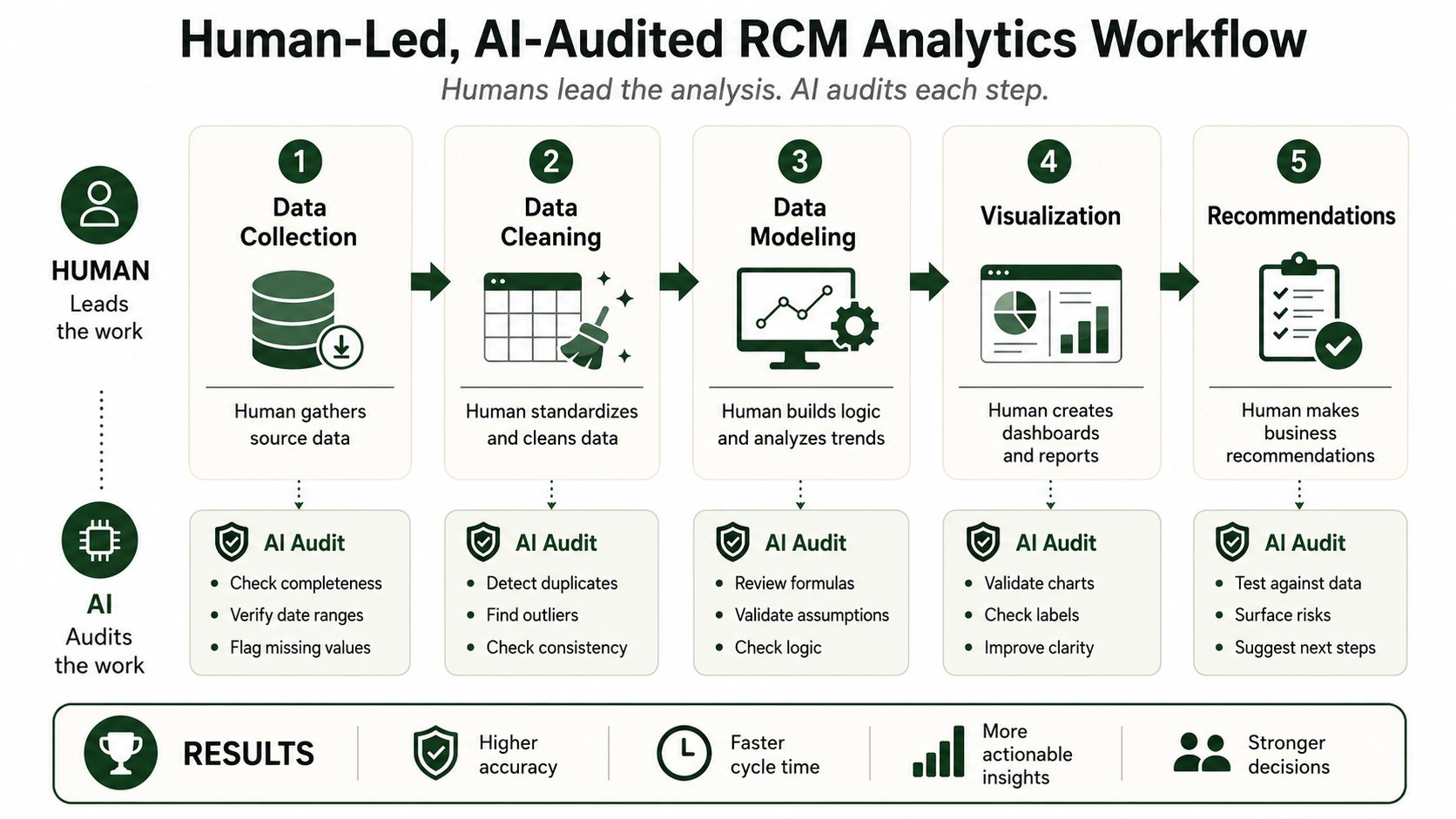
In this model, the human analyst still owns the process. The human collects the data, cleans the data, builds the model, creates the visualization, and makes the recommendation. But after each step, AI performs an audit. It checks for gaps, inconsistencies, anomalies, logic issues, and missed opportunities.
The goal is not to replace the analyst. The goal is to give the analyst a second set of eyes at every stage of the workflow.
Why RCM Needs a Better Analytical Workflow
Revenue cycle teams are already dealing with an operational environment where small errors can create large downstream consequences.
Experian Health’s 2025 State of Claims survey found that 41% of providers now face denial rates of 10% or higher. The same survey found that 54% of providers say claim errors are increasing, 68% say submitting clean claims is more challenging than a year ago, and 43% report being understaffed. Those numbers matter because denial management is not just a billing issue. It affects cash flow, staffing capacity, patient experience, and leadership’s ability to forecast revenue accurately.
McKinsey’s 2025 RCM Buyer’s Survey also points to a structural shift. The firm found that payer-related factors are contributing to aging accounts receivable for most surveyed care delivery organizations; 45% of respondents said cost to collect is rising, and 51% identified AI and advanced technologies as priority focus areas, up from 33% in the prior year’s survey. In other words, healthcare leaders are not looking at AI because it is trendy. They are looking at AI because the traditional revenue cycle operating model is struggling to keep pace with payer behavior, claim complexity, and workforce limitations.
The Human-First, AI-Audited Revenue Cycle Workflow
A practical RCM analytics workflow usually follows five stages:
- Data collection
- Data cleaning
- Data modeling
- Visualization
- Recommendations
In many organizations, a human analyst handles all five stages. That is appropriate because revenue cycle data requires context. A denial report is not just a spreadsheet. It may reflect payer behavior, authorization issues, registration errors, coding patterns, documentation gaps, facility-level workflows, and timing differences between billing and payment activity.
The risk is that each step creates opportunities for error.
A missing payer field can distort the analysis. A duplicate claim line can inflate volume. An incorrect grouping rule can misclassify denials. A visualization can overemphasize a trend that is not operationally meaningful. A recommendation can sound reasonable but fail to account for staffing, payer rules, or workflow realities.
That is where AI can help. The workflow should not be “AI does the work and the human reviews it at the end.”A better model is “the human does the work, and AI audits each step.”
For example:
After data collection, AI can review the file structure, field completeness, date ranges, payer mix, and missing values. After data cleaning, AI can identify duplicates, outliers, inconsistent naming conventions, unexpected nulls, and formatting issues. After modeling, AI can review formulas, assumptions, grouping logic, trend calculations, and whether the model answers the original business question. After visualization, AI can check whether the chart type fits the data, whether labels are clear, whether the visual overstates or understates the trend, and whether the dashboard supports decision-making. After recommendations, AI can pressure-test the conclusion. It can ask: Is this recommendation supported by the data? What alternative explanations exist? What operational constraint might leadership raise? What follow-up question should the analyst be ready to answer?
This creates a stronger workflow because the human maintains full context while AI strengthens quality control.
AI Should Accelerate Judgment, Not Replace It
One mistake healthcare organizations can make is treating AI as a shortcut around domain expertise.
In the revenue cycle, context matters too much for that.
A high denial rate may look like a coding issue, but the root cause may be eligibility, authorization, payer edits, documentation lag, registration errors, or a recent policy change. A spike in accounts receivable may look like a collections problem, but it may actually be tied to payer-specific delays, missing medical records, appeal backlog, or claim submission timing.
AI can identify patterns faster than a human team in many cases, but the human analyst is still needed to interpret whether those patterns are meaningful. That distinction is important. AI is useful when it expands the analyst’s ability to see the data clearly. It becomes risky when it creates a false sense of certainty.
A human-led, AI-audited workflow helps prevent that. The analyst remains responsible for the narrative, the assumptions, and the final recommendation. AI becomes an audit layer, not the owner of the decision.
The Cost Side of AI Matters Too
AI is not free.
Even when the user experience feels simple, AI usage comes with costs: model runs, compute, storage, integrations, monitoring, governance, security review, and staff training. For healthcare organizations, those costs also need to be considered alongside privacy, compliance, auditability, and data governance.
That means AI should be used intentionally.
The best use of AI in RCM analytics is not to run every task through an expensive model without discrimination. It is to apply AI where the review adds measurable value.
For example, AI may be most useful when:
- A dataset has a high volume of claim lines
- A report is tied to leadership decision-making
- A payer trend looks unusual
- A denial category is increasing unexpectedly
- A model will be reused monthly or quarterly
A recommendation could affect staffing, workflow design, or payer escalation strategy
This is where human oversight reduces cost. Instead of asking AI to do everything, the analyst decides when AI should audit, summarize, validate, or pressure-test the work.
That approach protects the organization from AI overuse. It also makes AI easier to justify because the tool is being applied to specific points of risk, not used as a blanket layer of automation. McKinsey’s survey found that healthcare leaders are showing stronger interest in AI and advanced technology, but expectations around near-term ROI have become more measured. Barriers include financial constraints, interoperability challenges, staff training, and change management.
That is a useful reminder: AI value does not come from buying the tool. It comes from designing the workflow.
AI as Institutional Memory
There is another benefit that may become even more important over time: institutional memory.
Revenue cycle teams carry a large amount of operational knowledge. Some of it is documented, but much of it lives in people’s heads.
Which payer changed their rules last quarter? Why did denials spike in March? Which facility has recurring registration issues? What logic did we use in last month’s dashboard? Which claim categories did leadership ask us to separate? What recommendation did we make the last time this issue came up?
When employees leave, change roles, or get pulled into other priorities, that context can disappear. Project management tools can help track tasks, owners, and deadlines, but they do not always preserve the reasoning behind decisions.
AI can help close that gap. If implemented well, AI can maintain context across recurring reports, meeting notes, dashboard logic, payer issues, denial trends, and prior recommendations. It can help a new analyst understand not only what was done, but why it was done. That matters in RCM because the work is repetitive, time-sensitive, and detail-heavy. Daily, weekly, monthly, and quarterly reporting cycles all depend on continuity.
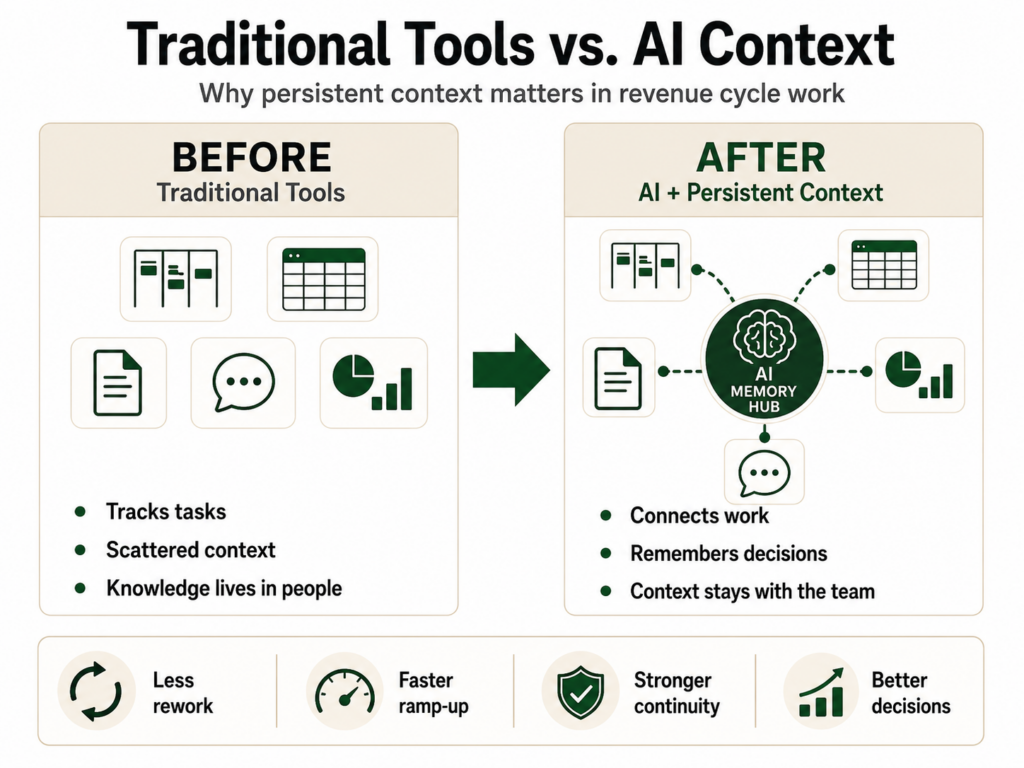
A traditional workflow might store the dashboard in one place, the meeting notes in another, the SQL query in another, and the business logic in someone’s memory. An AI-supported workflow can connect those pieces into a more searchable, explainable operating history. That does not mean AI replaces documentation or project management software. It means AI can sit across those tools and help preserve the connective tissue between them. For teams dealing with turnover, onboarding, cross-training, and constant task triage, that persistent context can be a major operational advantage.
What This Looks Like in Practice
Imagine a lab or hospital finance team reviewing denial trends every week. In the traditional workflow, the analyst pulls the data, cleans it, updates the dashboard, writes notes, and sends recommendations to leadership. If something is wrong, the issue may not be caught until the meeting, or worse, after a decision has already been made.
In a human-led, AI-audited workflow, the process changes.
The analyst still pulls the data. Then AI checks whether the file has the expected columns, date range, payer categories, and claim statuses.
The analyst still cleans the data. Then AI scans for duplicates, missing fields, outliers, and inconsistent payer names.
The analyst still builds the model. Then AI reviews the formulas, grouping logic, and assumptions.
The analyst still creates the dashboard. Then AI checks whether the visual actually answers the business question.
The analyst still writes the recommendation. Then AI pressure-tests whether the recommendation is supported by the data and what objections leadership may raise.
The result is a more reliable process. Not because AI is perfect, but because the workflow creates multiple checkpoints before the final recommendation is delivered.
Practical Outcomes for Revenue Cycle Teams
This type of workflow can support several measurable outcomes, including faster claim issue identification, cleaner denial trend reporting, better payer-specific analysis, improved accounts receivable visibility, stronger root cause analysis, and more consistent leadership reporting. It can also reduce rework, shorten onboarding time for new analysts, and improve continuity across daily, weekly, monthly, and quarterly reporting cycles.
The key is that AI is not being positioned as a magic solution. It is being used as an operational control. That framing is especially important in healthcare because revenue cycle teams do not just need speed. They need accuracy, auditability, and trust.
The Future of RCM Analytics Is Hybrid
The future of healthcare revenue cycle analytics is not purely manual, and it is not fully autonomous. It is hybrid. Humans bring judgment, context, accountability, and operational understanding. AI brings speed, pattern recognition, memory, and consistency. When paired correctly, the result is not just faster analysis. It is a stronger analytical operating model.
For labs and hospitals, this matters because revenue cycle pressure is not going away. Denials, payer complexity, staffing constraints, and rising cost to collect will continue to challenge teams. The organizations that benefit most from AI will not be the ones that simply add tools to old workflows. They will be the ones that redesign the workflow itself.
A human-led, AI-audited model is a practical place to start.
Sources
- McKinsey & Company — “Healthcare revenue cycle management at a strategic turning point: Survey insights”
Useful for supporting the argument that RCM is under margin pressure and that healthcare leaders are prioritizing AI, advanced tech, and new operating models. (McKinsey & Company) - Experian Health — “2025 State of Claims Survey”
Strong source for denial-rate pressure, claim errors, staffing shortages, and the need for cleaner claims workflows. It reports that 41% of providers now face denial rates of 10% or higher. (Experian) - Experian Health — “State of Claims 2025: The denial problem”
Good supporting source for the trendline in denials: 30% of providers reported 10%+ denial rates in 2022, 38% in 2024, and 41% in 2025. (Experian) - AKASA — “The Revenue Cycle Intelligence Report”
Useful for discussing how health systems are exploring, piloting, or implementing generative AI in revenue cycle workflows. The report highlights that 80% of health systems are now taking action on generative AI in RCM. (Akasa) - AKASA — “More Than 90% of Financial Leaders at Health Systems and Hospitals Say Automation Tools Should Be Purpose-Built for Healthcare RCM”
Useful for supporting the point that healthcare finance leaders do not just want generic automation; they want RCM-specific tools. (Akasa) - HFMA — “Healthcare CFO of the Future”
Good for the leadership angle. It supports the idea that CFOs need better data infrastructure, stronger strategy capacity, and more advanced use of automation/AI. (HFMA) - HFMA — “Predict, prevent, perform: The AI evolution of denials management”
Useful for supporting the argument that denial management is becoming too complex for legacy manual workflows alone. (HFMA) - American Hospital Association — “3 Ways AI Can Improve Revenue-Cycle Management”
Good source for a broader industry framing around AI, automation, payer denials, collections cost, and healthcare operations. (American Hospital Association) - HFMA — “How to use an enterprise approach in implementing AI in RCM”
Useful for the human-led workflow argument because it emphasizes workflow redesign, decision rights, governance, and operating model changes rather than just buying AI tools. (HFMA) - HFMA — “Automation and AI in Revenue Cycle Research”
Useful for survey-based support around AI and automation adoption in RCM. The survey included 272 HFMA healthcare provider members at manager level and above. (HFMA)